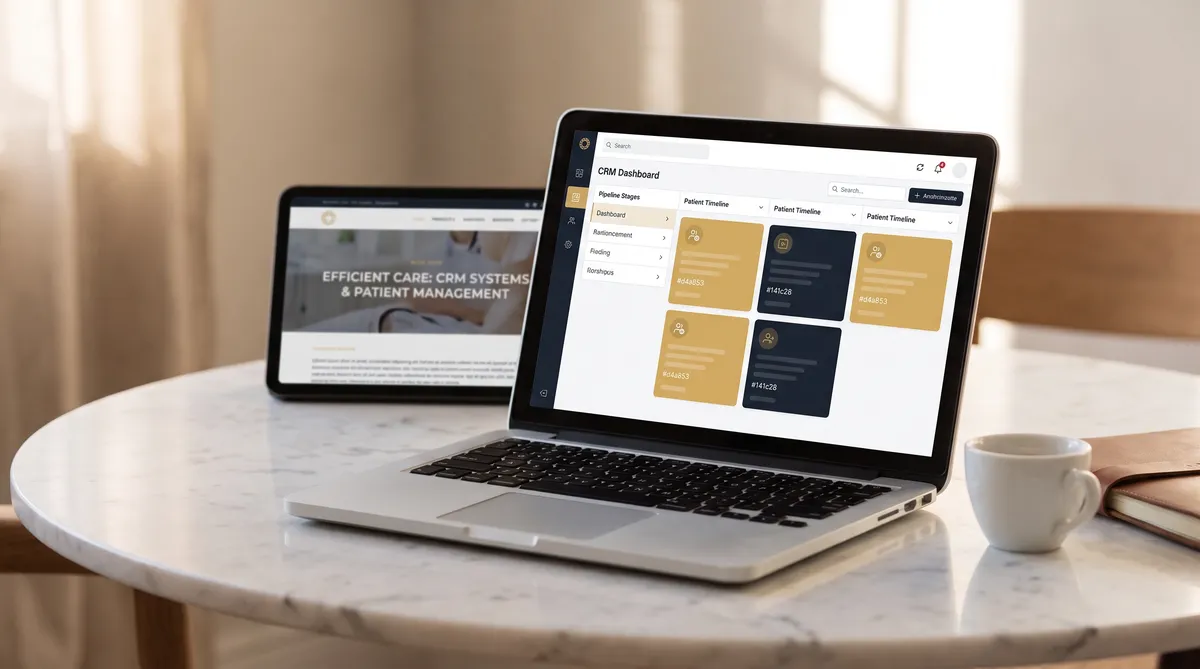
The best med spa CRM centralizes every patient interaction, automates follow-ups, and tracks revenue attribution across marketing channels. GoHighLevel works well for single-location practices at $97/month with built-in marketing automation. Aesthetic Record combines CRM with EMR for med spa-specific workflows. HubSpot suits multi-location practices with complex reporting needs. Implementation takes 6 to 12 weeks, and properly configured automations typically return 8 to 12x the platform cost within 90 days.
Your front desk is drowning. Leads come in from Google Ads at 9pm. Consultation requests sit in an inbox until Monday morning. A patient who spent $4,200 on a treatment package six months ago has not heard from you since their last appointment. Meanwhile, three other med spas in your city responded to that same lead within minutes.
This is not a staffing problem. It is a systems problem.
A CRM (Customer Relationship Management system) solves it by centralizing every patient interaction, automating the follow-ups humans forget, and giving you visibility into exactly where revenue leaks happen. But most med spas either choose the wrong platform, set it up incorrectly, or abandon it three months in because nobody taught them how to use it.
This guide covers the full process: what to look for, which platforms work for medical aesthetics, how to implement without disrupting your practice, and which automations generate revenue from day one. If you want to see how we configure and automate CRM systems for med spas, that page walks through our approach.
What a CRM should do for your med spa
A CRM is not a digital Rolodex. For a med spa, it should function as the central nervous system connecting your marketing, front desk, and treatment rooms. Here is what a properly configured system handles:
Lead capture and routing. Every inquiry from every channel (website form, phone call, Instagram DM, Google Ads click) lands in one system with a timestamp and source attribution. No more checking five different inboxes.
Pipeline management. Visual tracking of every patient from first inquiry through consultation, booking, treatment, and follow-up. You see exactly where patients stall and why.
Automated follow-up sequences. Email and SMS sequences that fire based on patient behavior, not manual reminders your team forgets to send.
Appointment reminders. Multi-step reminder sequences that reduce no-shows by 35 to 50% without your front desk making a single phone call.
Review requests. Timed requests after positive treatment outcomes that build your online reputation on autopilot.
Reporting and attribution. Clear data showing which marketing channels produce patients who actually book and return, not just leads who filled out a form and ghosted.
CRM vs. EHR vs. practice management software
Med spa owners often confuse these three systems. They serve different purposes and you likely need all of them:
EHR/EMR (Electronic Health Records) handles clinical documentation. Treatment notes, before-and-after photos, consent forms, medical history, prescriptions. Think Aesthetic Record, PatientNow, or Nextech. This is your clinical compliance system.
Practice Management Software (PMS) handles operations. Scheduling, inventory, point-of-sale, staff management. Often bundled with your EHR.
CRM handles the relationship. Everything before and between appointments: marketing, lead nurture, patient communication, review generation, Boomerang™ campaigns, and revenue tracking.
The mistake most practices make is assuming their EHR's built-in "marketing" features replace a real CRM. They do not. EHR marketing tools are an afterthought: basic email blasts with no segmentation, no automation triggers, no pipeline visibility, and no multi-channel communication.
Your EHR keeps you compliant. Your CRM keeps you profitable.
Top CRM platforms for med spas
After implementing and managing CRMs across dozens of med spa practices, these platforms consistently perform:
¶CRM comparison at a glance
| Platform | Med Spa Focus | Starting Price | Key Strength |
|---|---|---|---|
| GoHighLevel | General (widely used by med spas) | $97/month | All-in-one marketing automation, SMS, funnels, and pipeline management in one platform |
| Aesthetic Record | Purpose-built for med spas | $150/month | Combined EMR + CRM with treatment-specific templates |
| PatientNow | Purpose-built for aesthetics | $250/month | Clinical documentation and patient management designed for cosmetic practices |
| HubSpot | General (configurable) | Free (Pro: $800+/month) | Best-in-class reporting, integrations, and contact record detail |
| Salesforce Health Cloud | Healthcare enterprise | $300+/month per user | Unlimited customization, HIPAA-compliant architecture, enterprise-grade dashboards |
Pricing reflects publicly available rates as of mid-2026 and may vary by plan tier and feature set.
¶GoHighLevel
Best for single-location med spas wanting an all-in-one marketing and communication platform. Includes landing pages, email, SMS, call tracking, pipeline management, reputation management, and booking built into one system. Monthly cost starts around $97 for the base plan.
Strengths: Aggressive automation capabilities, built-in two-way SMS, call tracking, funnel builder, white-label options. One platform replaces five or six tools.
Limitations: Interface has a learning curve. Reporting is functional but not enterprise-grade. You need someone who knows the platform to configure it properly.
¶HubSpot
Best for multi-location practices or med spas with complex sales processes and larger teams. The free tier works for basic contact management, but the marketing automation features that matter require the Professional tier ($800+/month).
Strengths: Excellent reporting, clean interface, strong integrations ecosystem, superior contact record detail.
Limitations: Expensive at scale. SMS requires third-party add-ons. Not designed specifically for healthcare, so pipeline stages need custom configuration.
¶Salesforce Health Cloud
Best for large multi-location groups or practices planning aggressive expansion. Enterprise-grade customization with healthcare-specific compliance features.
Strengths: Virtually unlimited customization, HIPAA-compliant architecture, powerful reporting and dashboards.
Limitations: Requires a certified admin to configure and maintain. Implementation costs $10,000 to $50,000+. Overkill for most single-location practices.
¶Aesthetic Record
Best for practices wanting a combined EMR and CRM in one platform designed specifically for medical aesthetics.
Strengths: Purpose-built for med spas. Clinical documentation and marketing in one system. Treatment-specific automation templates.
Limitations: Marketing automation is less sophisticated than dedicated CRM platforms. You may outgrow it as your marketing matures.
Implementation timeline: weeks 1 through 12
Rushing a CRM implementation is the fastest path to abandonment. Your team needs time to adjust, and the system needs clean data to function. Here is a realistic timeline:
Weeks 1 to 2: Foundation. Migrate existing patient data. Clean duplicates. Set up pipeline stages matching your patient journey (New Lead, Consultation Booked, Consultation Complete, Treatment Booked, Active Patient, Lapsed Patient). Configure user permissions and integrations with your EHR and booking system.
Weeks 3 to 4: Core automations. Build the five revenue-generating automations (detailed below). Test each sequence with internal team members before going live. Connect lead sources so new inquiries route correctly.
Weeks 5 to 8: Team training and adoption. Train front desk on daily CRM workflow: how to update contact records, move patients through pipeline stages, log calls, and handle inbound leads. This is where most implementations fail. Without daily use, the data degrades within weeks.
Weeks 9 to 12: Optimization. Review automation performance metrics. Adjust timing, messaging, and triggers based on actual patient response data. Add secondary automations (birthday campaigns, Boomerang™ reactivation sequences, seasonal treatment promotions).
Five automations to build first
Not every automation generates equal revenue. Start with these five and add complexity later. Over-building on day one leads to confused patients and overwhelmed staff.
¶1. Speed-to-lead response (within 5 minutes)
When a lead submits a form, calls your tracking number, or sends a message, an automated SMS fires within 60 seconds acknowledging their inquiry and providing next steps. A follow-up email arrives within 5 minutes with more detail. If the lead does not respond within 2 hours, a second SMS follows.
According to research from Lead Connect, 78% of patients book with the first practice that responds. Your front desk cannot beat automation at 9pm on a Thursday.
¶2. Appointment reminder sequence
A three-touch sequence: confirmation email immediately after booking, SMS reminder 48 hours before the appointment, and a final SMS the morning of. Include preparation instructions specific to the treatment type. Practices running automated reminders see no-show rates drop from 15 to 20% down to 5 to 8%, based on MGMA data and Pronk client results.
¶3. Post-treatment follow-up
Twenty-four hours after treatment, an automated message checks in on the patient's experience. This accomplishes two things: it demonstrates care that builds loyalty, and it identifies unhappy patients before they leave a negative review. Seven days later, a review request fires to satisfied patients.
¶4. Review generation
Timing matters. The request goes out 24 to 72 hours post-treatment when results are visible and satisfaction is highest. Route happy patients to Google. Route patients who express concerns to a private feedback form your team monitors. This is the backbone of reputation management for growing practices.
¶5. Lapsed patient Boomerang™
Patients who have not visited in 90+ days receive a personalized sequence referencing their last treatment and suggesting relevant follow-up care. A patient who got Botox four months ago gets a "time to refresh" message. A HydraFacial patient at 45 days gets a maintenance reminder. These sequences recover 15 to 25% of lapsed patients without spending a dollar on new patient acquisition.
Common CRM mistakes that kill adoption
¶Over-automating too early
Sending 14 messages in a patient's first week feels like spam, not care. Start with the five essential automations above. Add complexity only after you understand how your patients respond. More automations is not better. More relevant automations is better.
¶Poor segmentation
Sending the same message to a prospective patient who has never visited and a loyal patient who visits monthly destroys trust with both. Segment at minimum by: pipeline stage, treatment interest, last visit date, and total lifetime value. Your email marketing strategy depends on this segmentation being accurate.
¶Not cleaning data
Duplicate contacts, wrong phone numbers, patients who opted out months ago still receiving messages. Dirty data makes every automation less effective and risks compliance violations. Run a data audit quarterly. Merge duplicates. Remove hard bounces. Update opt-out statuses.
¶Treating the CRM as optional
If your front desk only updates the CRM "when they have time," the system becomes unreliable within 30 days. CRM usage must be a non-negotiable part of the daily workflow, not an extra task layered on top of existing processes. The pipeline only works if the data reflects reality.
¶No clear ownership
Someone in your practice must own the CRM. Not "everyone is responsible" (which means nobody is responsible). One person monitors automation performance, ensures data quality, and flags issues. Without ownership, entropy wins.
Measuring CRM ROI
Your CRM is not a cost center. It is a revenue engine. Track these metrics monthly:
Speed to lead. Average time between inquiry submission and first response. Target: under 5 minutes during business hours, under 5 minutes after hours via automation.
Pipeline conversion rate. Percentage of leads who move from inquiry to booked consultation to completed treatment. Benchmark: 25 to 35% of inquiries should become consultations. 60 to 75% of consultations should become treatments.
No-show rate. Practices without automated reminders average 15 to 20% no-shows. With proper automation, target below 8%.
Patient reactivation rate. Percentage of 90+ day lapsed patients who rebook after receiving a Boomerang™ sequence. Healthy target: 15 to 25%.
Revenue per contact. Total revenue divided by total contacts in your database. This number should increase quarterly as your automations mature and you extract more value from existing relationships rather than constantly paying for new leads.
According to Nucleus Research, the average CRM returns $8.71 for every dollar invested. Med spas with properly configured automations typically exceed that because the lifetime value of a single patient relationship ($3,000 to $15,000+) makes every recovered lead disproportionately valuable.
The real cost of not having a CRM
Every day without a functioning CRM, your practice loses patients to competitors who respond faster, follow up more consistently, and stay top-of-mind between appointments. The leads you paid $50 to $200 each to acquire slip through the cracks because nobody called them back within the first hour. The patients who would have rebooked never received a reminder that their results are fading.
A CRM does not replace your team. It makes your team's effort compound instead of evaporate. One follow-up sequence running 24/7 outperforms the most dedicated front desk staff member who goes home at 6pm and takes weekends off.
The practices dominating their local market in 2026 have one thing in common: they treat their patient database as their most valuable asset and build systems to extract every dollar of lifetime value from it.
If your CRM is collecting dust, misconfigured, or nonexistent, you are leaving six figures on the table annually. That is not an exaggeration. It is math.
Schedule a Practice Growth Session and we will audit your current systems, identify the gaps, and show you exactly which automations would generate the fastest ROI for your specific patient base and treatment mix.
Ready to grow your practice?
Get a custom strategy for your med spa
Schedule Your Practice Growth SessionNo commitment required. No credit card.