Your Instagram ads look polished. The colors match your brand. The model is beautiful. And nobody is booking.
This is the most common problem we see when med spas bring us their Meta ad accounts. The creative looks "professional" in a way that blends into every other ad in the feed. It says nothing specific. It shows nothing memorable. It gives a scrolling patient zero reason to stop, watch, and tap through to book.
Instagram is a visual-first platform competing for attention against friends, influencers, and every other advertiser fighting for the same 25-to-54-year-old woman. Your ad has less than one second to earn a thumb-stop. Pretty is not enough. You need creative that interrupts, educates, and moves someone toward a booking in 15 to 30 seconds.
If you are looking for campaign structure, budget allocation, and audience targeting, read the companion piece on Facebook ads for med spas. This article is about what to actually put in front of people.
Why creative is the only lever that matters on Instagram
Meta's algorithm handles targeting better than you can. Broad audiences, Advantage+ placements, and machine learning optimization mean that the "who sees your ad" part is largely solved. What is not solved is the creative problem.
Your ad creative is now the primary variable that determines performance. Two ads running to the same audience with different creative can see a 5x difference in cost per lead. We see this in med spa accounts every week.
Here is what the data shows from campaigns we manage: Reels outperform static feed ads by 2.1x for med spa appointment bookings. That gap widens every quarter as Instagram continues prioritizing video content in its algorithm and placement mix.
The implication is clear. If your Instagram ad strategy is still built around static images with text overlays, you are paying a premium for worse results.
The four Instagram ad formats (and when to use each)
¶Reels ads (15 to 60 seconds)
Reels are your highest-performing format for awareness, engagement, and lead generation. They appear in the Reels tab, the Explore page, and the main feed. The audience reach is significantly wider than any other placement.
Treatment education videos between 15 and 30 seconds generate 67% lower cost per lead than promotional offers in our med spa campaigns. That is not a typo. Showing someone what a HydraFacial looks like, explaining what filler does over 3 weeks, or walking through a body contouring session simply performs better than "20% off this month."
What works in Reels:
- A provider explaining a treatment while performing it (split attention between camera and patient)
- The "one thing most people get wrong about [treatment]" hook
- Real treatment footage with text overlay narration (no voiceover needed)
- A 5-second before, 10-second treatment process, 5-second healed result sequence
- Provider answering the most common DM question about a specific treatment
What fails in Reels:
- Stock footage of a model touching her face
- Generic "we offer Botox, fillers, and laser" announcements
- Overproduced content that looks like a TV commercial
- Anything longer than 30 seconds that does not earn continued attention in the first 3 seconds
The hook matters more than anything else. Your first frame needs to be visually unexpected or pose a question that the viewer cannot answer without watching. "This is what 2 syringes of filler actually looks like" beats "Welcome to our med spa" by a margin you can measure in dollars.
¶Story ads (full-screen vertical)
Stories are your direct-response workhorse. The format is full-screen, immersive, and temporary by nature, which creates urgency that feed placements lack. Story ads with "Book Now" stickers convert at 2x the rate of feed-only placements for our med spa clients.
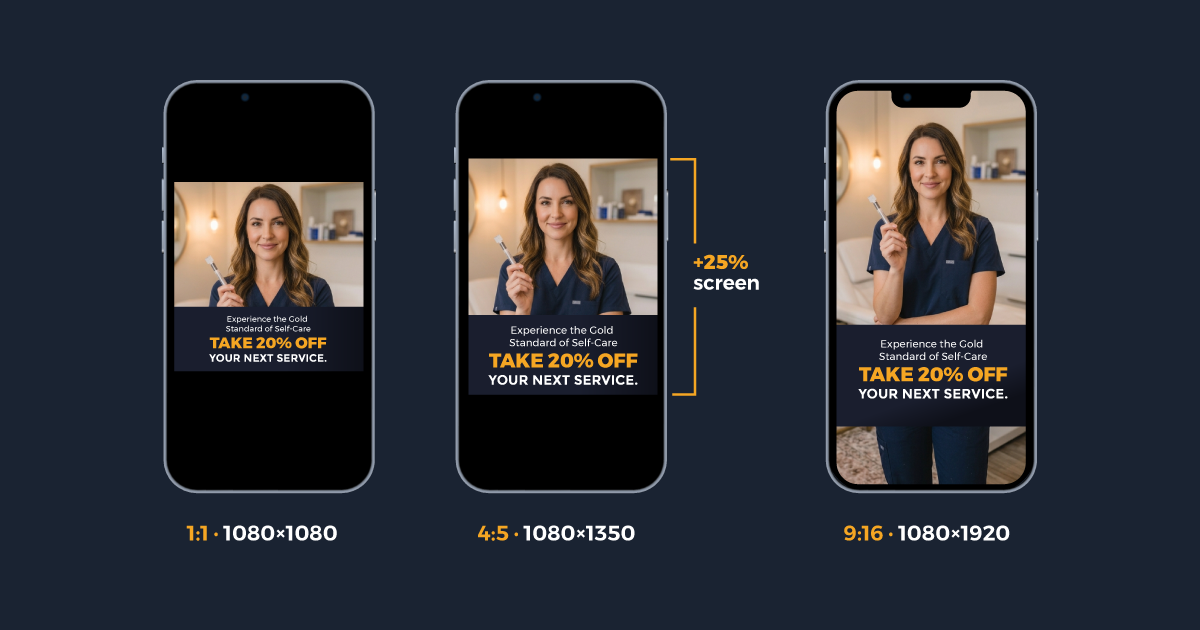
Story ads work best when they feel native to the Stories experience. That means vertical video shot on a phone, not a polished landscape clip forced into 9:16. It means casual, direct language. It means a clear CTA sticker, not a caption asking people to "click the link in bio."
Effective Story ad structures:
- The quick reveal. 3 seconds of treatment footage, then a text card with the result and a "Book Now" sticker. Total duration: 8 seconds.
- The countdown. "3 spots left for [treatment] this week." Simple text over a photo of your treatment room. Urgency without feeling like a used car lot.
- The provider tip. Your injector holds up a syringe and says one sentence about who is the ideal candidate for a treatment. 6 seconds. Direct.
Story ads disappear fast. You need to communicate one idea and one CTA. Do not try to explain your entire treatment menu in a 15-second Story.
¶Carousel ads (2 to 10 cards)
Carousels give you the space to tell a longer story without requiring video production. They work particularly well for treatment education and building brand trust because each swipe deepens engagement.
High-converting carousel structures for med spas:
- Treatment timeline. Card 1: "What [treatment] looks like at Day 1." Card 2: Day 3. Card 3: Day 7. Card 4: Day 14. Card 5: Final result. This educates while building anticipation.
- Myth-busting. Each card addresses one misconception about a treatment. "Myth: Botox freezes your face." Flip to next card: "Reality: Proper dosing allows natural movement."
- Provider introduction. Card 1: Photo of your injector. Card 2: Their credentials. Card 3: Their specialty. Card 4: A patient result. Card 5: CTA to book with them specifically.
Carousels generate longer session times and higher engagement rates than single-image ads. Meta's algorithm rewards that engagement by showing your ad to more people at a lower cost.
¶Single-image feed ads
Static images still have a role, but it is narrowing. They work for retargeting audiences who already know your practice. They work for simple promotional offers to warm audiences. They do not work as your primary prospecting creative.
If you are running single-image ads to cold audiences, you are leaving money on the table. Shift that budget toward Reels and Story formats.
What to show (and what will get your ad rejected)
Instagram advertising for med spas operates inside strict Meta advertising policies and HIPAA compliance requirements. Understanding the boundaries determines whether your ads run or get rejected within hours.
¶What you can show
- Treatment processes (injections, laser applications, skincare procedures)
- Your practice interior, equipment, and providers
- Patient testimonials with proper written consent
- Educational content explaining how treatments work
- Results shown naturally (not before/after comparisons)
- Provider credentials, training, and specializations
¶What gets rejected or puts you at risk
- Direct before-and-after comparisons (Meta policy violation)
- Claims about guaranteed results or specific outcomes
- Patient photos without signed HIPAA authorization
- Body-shaming language or imagery implying a "problem" with someone's appearance
- Pricing that could be considered bait-and-switch
- Any audio or footage from a patient who has not signed a marketing consent form
The before-and-after restriction is the one that trips up med spas most often. You cannot show a side-by-side. But you can show a "healed result" photo on its own with context in the caption. You can show a series of progress photos over time in a Reel. You can have a patient describe their results in a testimonial video. For more on compliant photo usage, see our full guide on before-and-after photos for med spas.
The line is nuanced, and Meta's automated review system is inconsistent. Build creative that clearly falls within policy rather than testing the edges.
Ad copy and hooks that work for aesthetic treatments
The visual stops the scroll. The copy closes the click. You need both working together.
¶Opening hooks (first line of primary text)
Your first line appears above the "See more" truncation. It needs to earn the expansion. These structures consistently generate high click-through rates for med spa ads:
- Question hooks. "Considering [treatment] but not sure if you are a candidate?" Direct, specific, self-qualifying.
- Outcome hooks. "Most patients see [specific result] within [timeframe]." Concrete, measurable, non-hyperbolic.
- Misconception hooks. "You have probably heard that [treatment] hurts. Here is what it actually feels like." Addresses the objection before they raise it.
- Authority hooks. "[Provider name] has performed over 3,000 [treatments] in the last 4 years." Specific credibility that cannot be faked.
¶Copy structures that convert
The body of your ad copy should follow one of these patterns:
Problem-process-proof. State the patient's frustration. Explain how the treatment solves it. Provide one piece of social proof. End with a CTA.
Single objection destroyer. Pick the number one reason someone hesitates to book (usually price, pain, or downtime). Address it directly with specifics. Then invite the booking.
Provider voice. Write the ad in first person from your injector's perspective. "I recommend [treatment] for patients who..." This feels personal and authoritative simultaneously.
Avoid copy that sounds like it came from a template. "Unlock your best self" and "Reveal your inner beauty" and "You deserve it" are phrases that every med spa uses, which means none of them stand out. Be specific to your practice, your providers, and the treatments you want to fill.
Behind-the-scenes content outperforms everything you think it will
Here is a number that surprises most practice owners: our med spa clients see 3.8x more engagement on behind-the-scenes content compared to polished studio shoots.
This runs against every instinct. You spent money on professional photography. You have beautiful branded imagery. Why would a shaky iPhone video of your injector organizing her supplies outperform it?
Because authenticity signals trust. A potential patient is about to let someone put a needle in her face. She does not care that your waiting room looks like a magazine spread. She cares that the person performing the treatment seems competent, warm, and real.
Behind-the-scenes content that works as paid creative:
- Your provider explaining why they chose a specific technique for a patient
- Morning routine at the practice (prep, setup, team interaction)
- The consultation process from the patient's perspective
- Equipment being calibrated or set up (signals precision and care)
- Team training sessions or continuing education moments
You do not need a videographer for this. A front desk coordinator with a steady hand and a smartphone produces content that feels more authentic than a $5,000 production day. The medium matches the message.
Building a creative testing system
Running the same three ads until they die is not a strategy. Instagram ad performance degrades as frequency increases. You need a system that produces fresh creative consistently and tests variations against each other.
Here is the framework we use for med spa Meta ad campaigns:
Week 1-2: Launch 3 to 4 new creative concepts (different formats, hooks, and angles). Let Meta optimize delivery.
Week 3: Identify the top performer. Create 2 to 3 variations of it (same hook, different visual; same visual, different hook; same concept, different provider).
Week 4: Pause underperformers. Promote winners. Begin developing the next batch.
This cycle means you are always learning. You discover which hooks resonate, which providers generate the most engagement, which treatments people want to see more of. Over 90 days, you build a creative playbook specific to your market and your patient base.
Most practices produce content reactively. They scramble for new creative when performance drops. By then, you have already wasted budget on fatigued ads. Build the content pipeline before you need it.
The organic-to-paid content pipeline
Your organic social media content is a free testing ground for paid creative. Every Reel you post organically gives you data. If a treatment walkthrough gets 3x your average views, that concept belongs in a paid campaign.
The pipeline works like this:
- Post 3 to 5 Reels per week organically
- Track which ones over-index on saves, shares, and profile visits (not just likes)
- Take the top 2 performers from the past 2 weeks and run them as paid Reels ads
- The algorithm already validated the content. You are adding budget to proven winners.
This approach removes guesswork from creative testing. You arrive at your paid strategy with evidence rather than assumptions. And it ensures your paid and organic efforts reinforce each other instead of running in parallel without connection.
What not to waste money on
Some creative approaches seem logical for med spas but consistently underperform. Save your budget:
Generic lifestyle imagery. A woman smiling at a sunset does not communicate anything about your practice. It could be an ad for vitamins, a hotel, or a credit card.
Discount-first messaging. Leading with "50% off" attracts price shoppers who will never become loyal patients. According to Hootsuite's 2025 Social Media Trends report, value-driven content outperforms promotional content for service-based brands by a significant margin.
Overly branded content. Your logo watermark, brand colors, and tagline do not need to dominate every frame. The ad needs to serve the viewer, not your internal brand guidelines.
Celebrity or influencer aesthetics. Your patients want to see people who look like them. A relatable patient testimonial outperforms an aspirational model photo for conversion every time.
Treatment menu dumps. "We offer Botox, fillers, laser, CoolSculpting, HydraFacial, and more." This tells someone everything and nothing. Focus each ad on one treatment with one message.
Putting it together
The med spas winning on Instagram right now share a few characteristics. They produce video-first creative on a consistent schedule. They lead with education over promotion. They let their providers be visible and human rather than hiding behind brand aesthetics. They test constantly and kill underperformers quickly.
None of this requires a massive production budget. It requires a system, a willingness to show up on camera, and someone paying attention to what the data says about which creative actually puts patients in chairs.
If your Instagram ads are running but not converting, the answer is almost certainly in the creative. Not the targeting. Not the budget. Not the landing page. The creative.
Start with one Reels ad showing a treatment your practice does well. Have your provider explain it in 20 seconds while performing it. Run it for two weeks. Then build from there.