You spent $4,000 on Facebook ads last month. You got likes, comments, shares, and 47 "link clicks" that Meta reported with confidence. Then you checked your booking calendar. Three new consultations. Maybe four.
That is a $1,000+ cost per booked patient. For a $400 Botox appointment, that math does not work.
The problem is not Facebook. The platform still reaches more potential patients in your city than any other channel besides Google. The problem is how most med spas run their campaigns: one broad audience, one generic ad, one "learn more" button pointing at the homepage. That setup fails because it ignores how people actually decide to book aesthetic treatments.
This guide gives you the exact campaign structure, targeting, creative, and budget allocation that drives $22 to $38 cost per booked consultation, based on Pronk client data. Not cost per click. Not cost per "engagement." Cost per person who shows up at your practice with a credit card.
Why Facebook still matters for med spas
Google Ads capture patients who already want a specific treatment. Someone searching "Botox near me" has made their decision. Google Ads for med spas should always be your first paid channel for that reason.
But Google only captures existing demand. It does not create it.
Facebook and Instagram create demand. They put your treatments in front of people who match your ideal patient profile but have not started searching yet. A 38-year-old woman scrolling Instagram sees a before-and-after of a patient with similar skin concerns. She did not wake up thinking about filler, but now she is considering it. That is demand generation, and Meta is the best platform for it in aesthetics.
The visual nature of the platform matters too. Aesthetic treatments sell on results. Instagram and Facebook let you show those results in full-screen video, carousel formats, and Stories that feel native to how people browse. A text-heavy Google Search Ad cannot do that.
The campaign structure that actually works
Most med spa owners run one campaign with one ad set and wonder why performance stalls after two weeks. Meta's algorithm needs room to optimize. It needs clear signals about what "success" means for each campaign. And it needs enough budget distributed across the right objectives to move people from awareness to booked appointment.
Here is the structure we build for every Meta Ads client, in the order you should launch them.
¶Campaign 1: Retargeting (launch first)
Start here, even though it feels backwards. Retargeting campaigns reach people who already visited your website, watched your videos, or engaged with your social profiles. These are your warmest audiences, and they convert at 3 to 5x the rate of cold traffic.
Objective: Conversions (optimized for booking or form submission)
Audiences:
- Website visitors, last 30 days (exclude people who already booked)
- Video viewers who watched 50%+ of any treatment video
- Instagram and Facebook engagers, last 60 days
Budget: 20 to 25 percent of your total Meta spend
Why launch first: Even if you have never run Facebook ads before, you have website traffic from Google, organic social, and referrals. Those visitors are already familiar with your practice. Converting them is the fastest path to positive ROAS. For a deeper breakdown of retargeting strategy, read our complete guide to med spa retargeting ads.
¶Campaign 2: Lookalike prospecting
This is your primary growth engine. You upload your existing patient list to Meta as a custom audience, then Meta builds a lookalike audience of people who share similar characteristics: demographics, behaviors, income levels, interests.
Objective: Conversions (optimized for booking or lead form)
Audiences:
- 1% lookalike of your patient list (highest similarity)
- 1% lookalike of your highest-value patients (those who spent $2,000+ lifetime)
- 2 to 3% lookalike as a separate ad set for broader reach
Budget: 40 to 50 percent of your total Meta spend
Lookalike audiences built from your existing patient list outperform interest targeting by 40 to 60 percent. The reason is simple: Meta's algorithm finds people who look like the patients who already chose you. Interest targeting guesses. Lookalikes learn from real data.
Geographic targeting: Restrict to your service radius, typically 15 to 25 miles. Layer on household income targeting if your area has wide income variance. Aesthetic patients with disposable income behave differently online than the general population in your zip code.
¶Campaign 3: Treatment-specific prospecting
Once your retargeting and lookalike campaigns are running profitably, add treatment-specific campaigns that target broader audiences with highly specific creative. Each campaign promotes one treatment category.
Objective: Conversions or Lead Generation (depending on treatment price)
Audiences:
- Interest targeting: "aesthetics," "anti-aging," "skincare," combined with income and age filters
- Broad targeting with Meta Advantage+ (let Meta's algorithm find converters)
Budget: 25 to 35 percent of your total Meta spend, split across 2 to 4 treatment campaigns
Best treatments to advertise on Facebook:
- Injectables (Botox, filler): lowest barrier to entry, broadest audience, fastest conversion
- Body contouring (CoolSculpting, Emsculpt): higher ticket, longer decision cycle, needs video creative
- Skin rejuvenation (laser, microneedling, chemical peels): mid-range pricing, visual results sell well
- Weight management (semaglutide, GLP-1): massive demand, high search volume, competitive
Run each treatment as its own campaign. Do not combine Botox and CoolSculpting in one campaign. Meta's algorithm optimizes toward the easiest conversions, which means it will show the Botox ad to everyone and starve the CoolSculpting ad of impressions.
¶Campaign 4: Boomerang campaigns (optional but profitable)
If your practice has a list of past patients who have not returned in 6 to 12 months, upload that list as a custom audience and run Boomerang™ campaigns to bring them back. These patients already trust you. They already had results. They just need a reason to return.
Objective: Conversions
Audiences:
- Custom audience of lapsed patients (6 to 18 months since last visit)
Budget: 5 to 10 percent of total Meta spend
The cost per re-booked appointment on Boomerang™ campaigns is typically 50 to 70 percent lower than new patient acquisition because you skip the entire trust-building phase.
Creative that converts: what to show and what to say
Your ad creative does 80 percent of the work. Targeting puts the ad in front of the right person. Creative convinces them to act.
¶Video testimonials (best performer)
The best-performing ad format for med spas: video testimonials. They drive 2.4x more bookings than static images. A real patient on camera, talking about their experience and showing their results, builds trust faster than any stock photo or graphic design.
What makes a strong testimonial video:
- 30 to 60 seconds long (trim ruthlessly)
- Patient speaks directly to camera in natural lighting
- They describe the problem they had before treatment
- They show or describe their results
- No scripted language. Real words from real people.
- Add captions (85% of Facebook video is watched on mute)
You do not need a production crew. An iPhone in portrait mode with good window lighting produces videos that outperform polished commercial-style content. Authenticity beats production value every time on social media.
¶Before-and-after carousels
Carousel ads with 3 to 5 before-and-after images, each showing a different patient or angle, generate high engagement and strong click-through rates. Each card should show one transformation with minimal text overlay.
Compliance note: Follow Meta's advertising policies for healthcare. Avoid implying guaranteed results. Use language like "individual results may vary" and ensure you have written patient consent for all photos. Read our HIPAA-compliant advertising guide for the full breakdown.
¶Offer-driven static ads
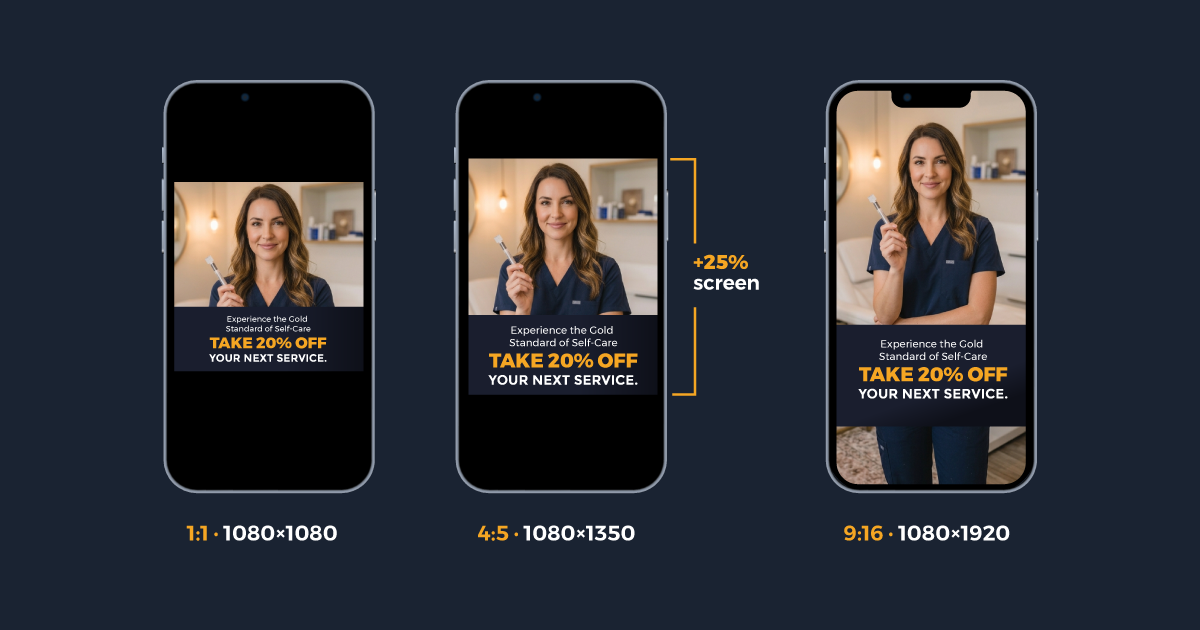
For promotions, seasonal events, or new patient specials, static image ads with a clear offer outperform awareness-style creative. State the offer clearly: "$50 off your first Botox treatment" performs better than "Look your best this summer" because it gives the viewer a specific reason to act now.
Static ad formula:
- Headline that states the offer or outcome (not your practice name)
- One strong image showing results or the treatment environment
- Social proof line in the primary text (reviews, years of experience, number of patients treated)
- Clear call-to-action button (Book Now or Learn More, depending on treatment price)
¶What to write in your ad copy
Your primary text (the copy above the image or video) should follow a simple structure:
- Open with the patient's problem or desire (not your practice name)
- Agitate with specificity. What does that problem feel like or cost them?
- Present the treatment as the solution. Include one proof point.
- Clear CTA with urgency or scarcity if applicable.
Example for Botox:
"You started noticing the lines between your brows in every Zoom call. Foundation does not hide them anymore. Botox smooths those lines in one 15-minute appointment. Most patients see full results within 7 days. [Practice Name] has performed 2,000+ Botox treatments in [City]. Book your consultation this week and get $50 off your first treatment."
Short, specific, and focused on what the patient wants. No jargon. No "state-of-the-art facility" language.
Budget allocation and what to expect
Your total monthly Meta Ads budget depends on your market size, competition, and how aggressively you want to grow. Here is a framework based on practice size.
Starter budget ($2,500 to $3,500/month):
- Retargeting: $500 to $700
- Lookalike prospecting: $1,200 to $1,800
- One treatment-specific campaign: $800 to $1,000
Growth budget ($4,000 to $6,000/month):
- Retargeting: $800 to $1,200
- Lookalike prospecting: $1,800 to $2,400
- Two to three treatment campaigns: $1,200 to $2,000
- Boomerang™ campaign: $200 to $400
Aggressive budget ($7,000 to $12,000/month):
- Retargeting: $1,400 to $2,400
- Lookalike prospecting: $2,800 to $4,800
- Four to five treatment campaigns: $2,000 to $3,600
- Boomerang™ campaign: $400 to $600
- Testing budget (new creative, audiences): $400 to $600
Use our ad spend calculator to model your expected return based on treatment pricing and conversion rates.
We typically see 4 to 7x ROAS on treatment-specific campaigns within 60 days of launch. That means for every $1,000 spent, the practice books $4,000 to $7,000 in treatment revenue. The first 2 to 3 weeks are the "learning phase" where Meta's algorithm tests combinations of audiences, placements, and creative. Performance improves steadily after that initial period.
According to WordStream's social media advertising benchmarks, the average cost per action across all industries on Facebook is $18.68. Med spas running optimized campaigns consistently beat that on consultations booked.
Targeting deep dive: audiences that perform
¶Custom audiences (your data)
The most valuable targeting asset you own is your patient list. Upload it to Meta as a custom audience and you unlock two things: direct targeting of those patients (for Boomerang™ campaigns) and lookalike audiences that mirror their characteristics.
What to upload:
- Full patient list (name, email, phone, city, state, zip)
- Segmented lists: high-value patients, specific treatment patients, lapsed patients
- Email subscribers who have not yet booked
Meta matches 40 to 70 percent of your list to Facebook profiles, depending on data quality. The more fields you include per record, the higher your match rate.
¶Lookalike audiences (Meta's data)
Once your custom audience is uploaded, create lookalike audiences at different percentage levels:
- 1% lookalike: most similar to your patients, smallest audience, highest conversion rate
- 2 to 3% lookalike: broader reach, slightly lower conversion rate, good for scaling
- 5%+ lookalike: too broad for most local med spas, avoid unless your budget exceeds $10,000/month
¶Interest and demographic targeting (supplement only)
Interest targeting should supplement your lookalikes, not replace them. When you run treatment-specific campaigns to broader audiences, layer these filters:
Demographics:
- Age: 28 to 62 (varies by treatment; Botox skews 30 to 50, body contouring skews 35 to 55)
- Gender: target based on your treatment mix (most med spas see 80 to 85% female patients)
- Household income: top 25 to 30% in your zip codes
- Geography: 15 to 25 mile radius from your practice
Interests:
- Skincare, anti-aging, specific brand names (Allergan, Galderma)
- Fitness, wellness, health-conscious behaviors
- Luxury goods, spa services, self-care
Avoid overly narrow interest stacking. Give Meta enough audience size (minimum 100,000 people in your geographic target) so the algorithm can optimize effectively.
Tracking and measurement: what actually matters
Stop looking at cost per click. Stop celebrating link clicks. The only metrics that matter for a med spa Facebook campaign are tied to revenue.
Primary metrics:
- Cost per booked consultation (target: $22 to $45 depending on treatment, based on Pronk client data)
- ROAS (target: 4x+ within 60 days)
- Cost per qualified lead (form fills or calls that meet your criteria)
Secondary metrics (optimization signals):
- Click-through rate (benchmark: 1.5 to 3% for med spa ads)
- Cost per 1,000 impressions (indicates auction competitiveness)
- Frequency (keep below 3.0 for prospecting, below 6.0 for retargeting)
- Video view rate (for video ads, 25%+ view rate is strong)
What to track in your CRM:
- Which leads came from Meta (UTM parameters on every landing page URL)
- Which leads booked consultations
- Which consultations converted to paid treatments
- Revenue generated per campaign
Without CRM tracking tied to your ad campaigns, you cannot calculate true ROAS. You are guessing. Most practices that say "Facebook ads do not work" have a measurement problem, not a performance problem. For context on how this fits into your overall advertising strategy and marketing budget, connect the dots between channels so nothing runs in isolation.
Common mistakes that kill med spa Facebook campaigns
Sending traffic to your homepage. Build dedicated landing pages for each treatment campaign. A person who clicked a Botox ad should land on a Botox-specific page with Botox results, Botox pricing context, and a Botox-specific booking CTA. Homepage visitors convert at 2 to 3 percent. Dedicated landing pages convert at 8 to 15 percent.
Running one ad until it dies. Creative fatigue sets in after 7 to 14 days for most med spa audiences. Your prospecting campaigns need 3 to 5 active ad variations at all times, with new creative rotating in every 2 weeks. Retargeting can run longer because the audience refreshes naturally as new visitors hit your site.
Optimizing for link clicks instead of conversions. When you tell Meta to optimize for link clicks, the algorithm finds people who click on things. Not people who book. Always optimize for the conversion event closest to revenue: form submissions, calls, or booking confirmations.
Ignoring the learning phase. Meta needs approximately 50 conversion events per week per ad set to exit the learning phase and optimize effectively. If your daily budget is too low or your conversion event is too rare, your campaigns never leave the learning phase and performance stays volatile. For med spas, this typically means a minimum of $30 to $50 per day per ad set.
No exclusions. Always exclude existing patients from your prospecting campaigns (unless running Boomerang™ campaigns specifically to them). Always exclude people who booked in the last 30 days from retargeting. Without exclusions, you waste budget showing ads to people who already converted.
Putting it together: your 90-day launch plan
Days 1 to 7: Install Meta pixel with Conversions API. Upload patient list. Create custom audiences and lookalike audiences. Build landing pages for your top 2 treatments.
Days 8 to 14: Launch retargeting campaign to website visitors and social engagers. Launch lookalike prospecting campaign with 3 to 5 ad variations (mix of video and carousel).
Days 15 to 30: Monitor performance daily. Let campaigns exit the learning phase (do not make changes during this period unless something is clearly broken). Identify top-performing creative.
Days 31 to 60: Add treatment-specific prospecting campaigns for your top revenue treatments. Scale budget on winning ad sets by 20 percent every 5 to 7 days. Rotate in new creative to combat fatigue.
Days 61 to 90: Launch Boomerang™ campaign to lapsed patients. Test new audiences (3 to 5% lookalikes, broader interest targeting). Evaluate full-funnel ROAS and adjust budget allocation across campaigns.
By day 90, you should have a clear picture of your cost per booked consultation by campaign, your ROAS by treatment type, and which creative formats drive the best results for your specific practice and market.
When to pair Facebook with Google Ads
Facebook and Google are not competing channels. They serve different stages of the patient journey. Google captures people who already want a treatment. Facebook creates desire in people who match your ideal patient profile but have not started searching.
The strongest med spa advertising programs run both. Google Ads capture the high-intent bottom of funnel. Facebook builds the top of funnel and retargets people across the entire decision window. When you run them together, you will notice Google Ads performance improves because Facebook is warming up audiences before they ever search. Read our full advertising guide for how to allocate budget across channels.
The bottom line
Facebook ads work for med spas when you build the right structure: separate campaigns for retargeting, lookalike prospecting, and treatment-specific outreach. Match your creative to the audience temperature. Track through to booked revenue, not vanity metrics. And give the algorithm enough budget and time to optimize.
The practices that fail on Facebook treat it like Google. They run one campaign, send traffic to the homepage, and expect immediate bookings from cold audiences. That is not how social advertising works. You build warm audiences over time, nurture them with relevant creative, and convert them when they are ready.
If you want a team that builds and manages this entire system for your practice (and guarantees no competing med spa in your city runs the same playbook), schedule your Practice Growth Session. We work with one practice per market. Check if your city is available.