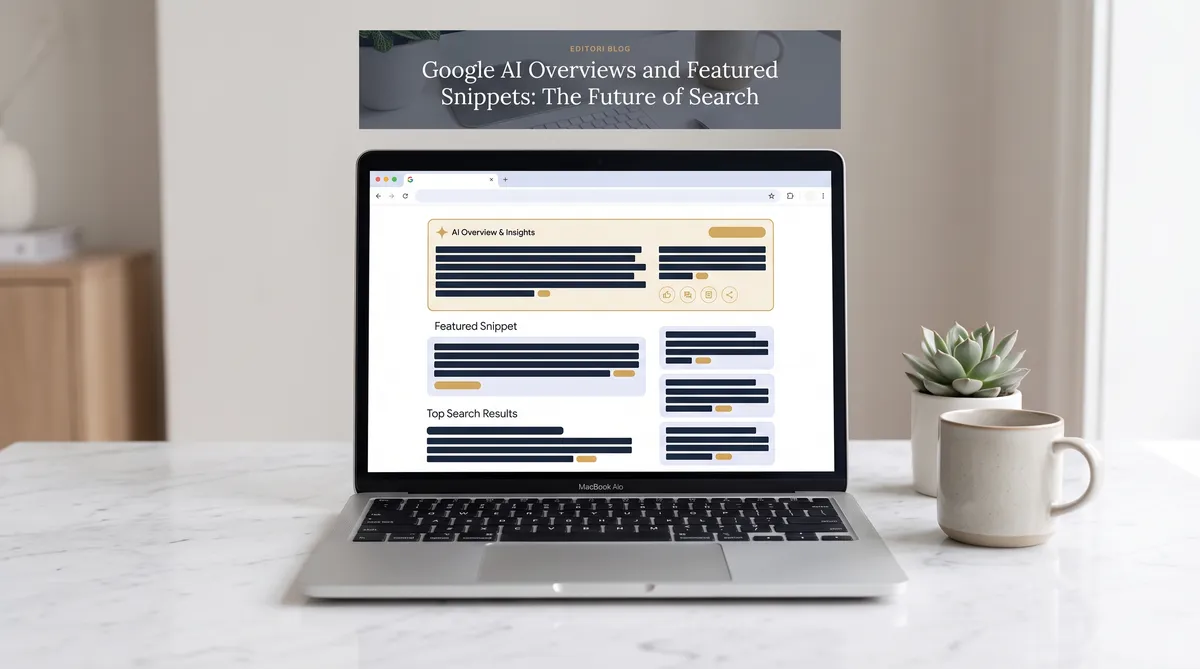
Google AI Overviews now appear above organic results for nearly half of all med spa treatment queries. That blue box at the top of the page synthesizes answers from multiple sources, gives patients what they need, and often keeps them from scrolling any further.
If your practice is not being cited as a source within those overviews, you are losing patient inquiries to competitors who are. Not eventually. Right now.
For the complete guide to AI search optimization for med spas, read AI Search Optimization for Med Spas: A Step-by-Step Guide.
We covered AI search visibility broadly in a previous piece, including ChatGPT, Perplexity, and Gemini. This piece focuses specifically on Google AI Overviews: how Google selects sources, what content structures earn citations, and the concrete steps your practice can take to get featured.
How Google AI Overviews actually work
Google AI Overviews use a large language model to read, synthesize, and summarize information from multiple web pages. When a patient searches "how much does Botox cost" or "is microneedling worth it," Google's AI reads the top-ranking pages, identifies consensus information and unique data points, and generates a summary paragraph with source citations linked below.
The AI Overview appears in a distinct panel above the traditional organic results. It includes a written summary (typically 100 to 250 words), followed by clickable source links on the right side or below the summary. Patients can expand or collapse the overview, but the default state is open, meaning traditional organic results are pushed below the fold on most screens.
The system does not pull from a separate index. It draws from the same pages that rank organically. That is the critical point most med spa owners miss. Strong organic SEO is not separate from AI Overview visibility. It is the prerequisite.
According to Google's documentation on AI Overviews, the system prioritizes content that demonstrates experience, expertise, authoritativeness, and trustworthiness. For medical aesthetics content, that means properly attributed clinical information, author credentials, and transparent sourcing.
Which med spa queries trigger AI Overviews
Not every search generates an AI Overview. Google applies them selectively based on query type and complexity.
High-frequency AI Overview triggers for med spas:
- Treatment comparison queries ("Botox vs. Dysport," "microneedling vs. laser resurfacing")
- Cost and timeline questions ("how much does a chemical peel cost," "how long do fillers last")
- Safety and eligibility questions ("is CoolSculpting safe," "can I get Botox while pregnant")
- Treatment process questions ("what happens during a HydraFacial," "does laser hair removal hurt")
- Recovery and aftercare queries ("Botox aftercare instructions," "how long is filler recovery")
Lower AI Overview frequency:
- Transactional local queries ("Botox near me," "best med spa in [city]") trigger AI Overviews roughly 25% of the time
- Branded queries (your practice name) rarely trigger them
- "Book appointment" or scheduling-intent queries almost never show an AI Overview
This distribution reveals something important for your content strategy. The informational queries that patients search during their research phase are exactly where AI Overviews dominate. If your practice owns those answers, you capture patients earlier in their decision process, before they ever search for a competitor by name.
How Google selects which sources to cite
Research from Authoritas and other industry studies shows clear patterns in how Google selects sources for AI Overview citations.
Organic ranking is the gatekeeper. Approximately 93% of cited sources rank within the top 10 organic results for that query. If you are on page two, the AI Overview will not cite you regardless of how good your content is.
Direct, structured answers win. Pages that answer a specific question in the first paragraph, then expand with supporting detail, are cited more frequently than pages that bury the answer beneath lengthy introductions.
Multiple sources per overview. Most AI Overviews cite three to six sources. You do not need to be the single best page. You need to be among the top five or six most relevant, authoritative pages for that query.
Freshness matters. Google's AI favors recently updated content, particularly for topics where information changes (pricing, treatment protocols, technology updates). A page last updated in 2023 loses ground to one refreshed in 2026.
Schema markup signals relevance. Pages with FAQ schema, MedicalCondition schema, and proper Organization markup get cited at disproportionately higher rates. The structured data helps Google's AI understand what your content covers and how it relates to the query.
Structuring your content to earn citations
The practices getting cited in AI Overviews build their content in specific ways. These are not minor tweaks. They are structural decisions about how you organize treatment pages and blog content.
¶Answer the question immediately
Your target query should be answered in the first 40 to 60 words of the page or section. Google's AI pulls from content that directly addresses the search intent without requiring the reader (or the AI) to parse through introductory material.
If the query is "how long does Botox last," your page should open with something like: "Botox results typically last 3 to 4 months, though some patients see effects for up to 6 months depending on metabolism, injection site, and dosage."
Then expand. Add your clinical experience, nuance, patient considerations, and treatment recommendations below that direct answer.
¶Use question-based H2 and H3 headings
Structure your treatment pages with headings that mirror actual patient queries. Instead of "Duration" as a heading, use "How long does Botox last?" Instead of "Pricing," use "How much does Botox cost in [your city]?"
Google's AI maps query intent to heading content. When your heading matches the search query pattern, the AI can identify the relevant section faster and is more likely to cite that specific section.
¶Implement FAQ sections with schema
Every treatment page should include 5 to 8 frequently asked questions with FAQ schema markup. These questions should target the long-tail informational queries that trigger AI Overviews at the highest rates.
Your SEO foundation should already include structured data. If it does not, that is your first priority before attempting AI Overview optimization.
¶Provide specific data points
AI Overviews love specificity. "Results vary" gets ignored. "Most patients see a 60 to 80 percent improvement in skin texture within 4 to 6 weeks" gets cited.
Include treatment timelines, typical costs (or ranges), number of sessions required, clinical study results, and measurable outcomes wherever possible. The AI gravitates toward content that gives patients concrete information rather than vague generalities.
¶Demonstrate E-E-A-T through author credentials
For medical content, Google's AI weighs authorship signals heavily. Treatment pages should include author information with credentials. Blog posts should carry a byline with relevant qualifications. About pages should detail clinical oversight and advisory relationships.
The relationship between AI Overviews and click-through rates
AI Overviews change the click equation significantly. When Google answers a question directly at the top of the page, fewer people click through to any website. But those who do click are further along in their decision process and more likely to book.
Industry data shows that queries with AI Overviews see a 30 to 40% reduction in clicks to organic results below position three. However, sources cited within the AI Overview actually see a 10 to 15% increase in click-through rate compared to their organic ranking alone. Being cited is not just a visibility play. It drives qualified traffic.
For med spas specifically, this creates a two-tier system:
- Informational content pages (blog posts, treatment guides) will see declining traffic from queries where you are not cited
- Being cited in the AI Overview partially offsets the overall CTR decline and sends more qualified visitors
- The patients who click through from an AI Overview have already read a summary and want deeper information. They convert at higher rates than cold organic traffic.
- Treatment pages that earn citations become disproportionately valuable because they capture a larger share of a shrinking click pool
Practices that are invisible to AI search are already losing this traffic. The decline accelerates each quarter as Google expands AI Overviews to more query types.
Tracking your AI Overview presence
Google Search Console does not yet break out AI Overview impressions or clicks as a separate metric. That makes tracking your citation presence harder, but not impossible.
Manual auditing. Search your top 20 target queries in incognito mode weekly. Note which queries trigger AI Overviews, whether your site is cited, and which competitors appear. Document changes over time.
Third-party tools. Ahrefs and Semrush now track AI Overview appearances in their SERP analysis features. These tools can show you which of your ranking keywords trigger AI Overviews and whether your pages are cited as sources.
Click pattern analysis. If a query suddenly drops in CTR without losing ranking position, an AI Overview likely appeared. Monitor Search Console for these patterns.
Competitor monitoring. Track which competitor pages are being cited. Analyze their content structure, word count, schema implementation, and heading patterns. Reverse-engineer what earned their citation. Pay particular attention to new citations that appear after a competitor updates a page, as that timing reveals what Google's AI responds to.
Position change correlation. When you gain or lose an organic ranking position, check whether your AI Overview citation status changed simultaneously. This helps you understand the ranking threshold for citation eligibility in your specific treatment categories.
We built our AI search optimization practice around tracking these metrics for med spa clients because the default tools do not provide the visibility needed.
What to do this quarter
Stop treating AI Overviews as a future problem. They are a current reality reshaping how patients find your practice. Here is the priority list:
-
Audit your organic rankings for AI Overview queries. Identify which of your target treatment queries trigger AI Overviews. If you do not rank in the top 10 for those queries, organic SEO comes first.
-
Restructure your top treatment pages. Add direct-answer opening paragraphs, question-based headings, FAQ sections with schema, and specific data points. One page at a time, starting with your highest-volume treatments.
-
Refresh dated content. Any treatment page last updated more than six months ago is losing AI Overview eligibility. Update pricing, add new clinical data, and revise outdated information.
-
Build supporting content. For each core treatment, create two to three blog posts targeting the long-tail informational queries that trigger AI Overviews at the highest rates. Link them back to your main treatment page.
-
Monitor and iterate. Check your AI Overview citations monthly. When you earn a citation, study what worked. When a competitor takes one from you, analyze what changed.
The practices that act on this now will own the AI Overview citations in their markets for the next 12 to 18 months. The ones that wait will spend that same period trying to catch up, competing against entrenched competitors who already hold those citation positions.
Ready to grow your practice?
Get a custom strategy for your med spa
Schedule Your Practice Growth SessionNo commitment required. No credit card.