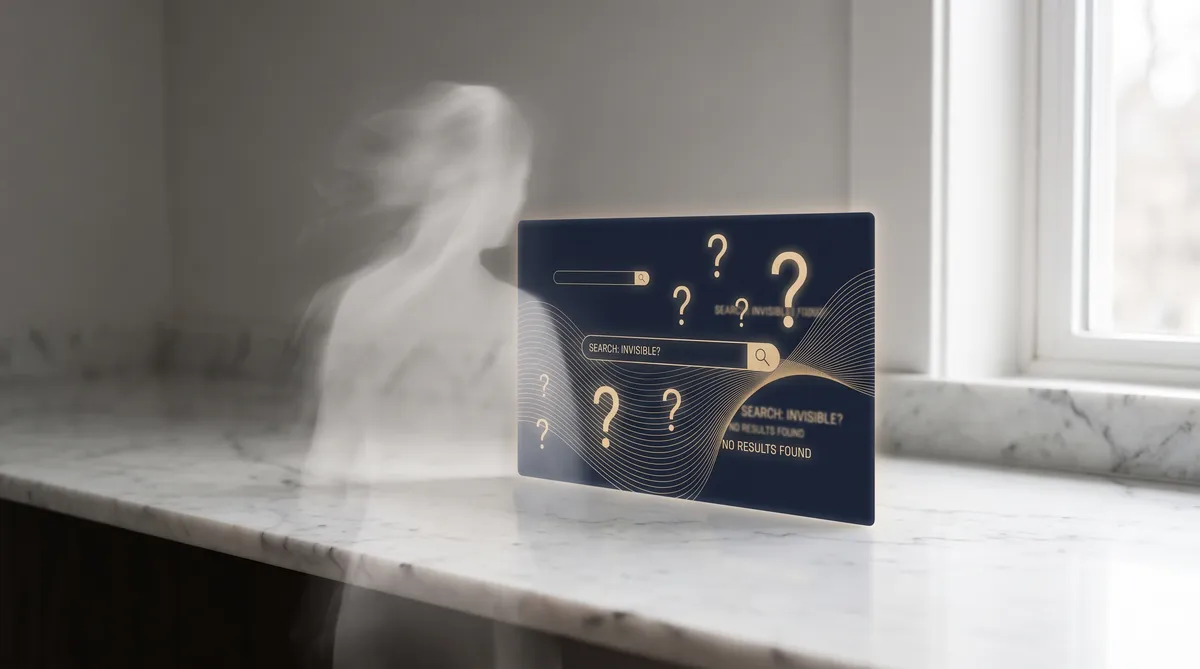
You rank on Google. Your website looks polished. You even run ads. But when a potential patient asks ChatGPT "What's the best med spa in [your city] for Botox?" your practice does not appear anywhere in the response.
This is not a hypothetical scenario. In Pronk's audits of med spa AI visibility across more than 50 markets, 82% of practices did not appear in any AI-generated recommendations for their city. Not in ChatGPT. Not in Perplexity. Not in Google's AI Overview. These practices are functionally invisible to a growing segment of patients who now start their search with an AI tool instead of a traditional Google query.
The shift happened fast. Patients who used to type "best med spa near me" into Google now ask their AI assistant the same question in natural language. And AI tools do not return 10 blue links. They return one or two specific recommendations, with names attached. If you are not one of those names, you do not exist in that conversation.
Here is how to check whether your practice is invisible, why it matters more than you think, and what to do about it.
For the complete guide to AI search optimization for med spas, read AI Search Optimization for Med Spas: A Step-by-Step Guide.
The 5-minute AI visibility check
You can diagnose your AI visibility right now. Open four tabs and run these exact prompts. Copy them verbatim. Do not add "please" or extra context, because that changes the results.
¶ChatGPT (GPT-4o or newer)
Type each of these prompts separately:
What are the best med spas in [your city] for [your top treatment]?I want to get Botox in [your city]. Where should I go?Which med spa in [your city] has the best reviews?Compare the top med spas in [your city] for laser treatments.
¶Perplexity
Run the same four prompts in Perplexity. Perplexity shows its sources, so you can see exactly which websites it pulled from. This tells you not just whether you appear, but who is appearing instead of you.
¶Google AI Overview
Search Google for these queries (you need to be logged into a Google account with AI Overview enabled):
best med spa [your city][your top treatment] [your city] recommendationswhere to get [treatment] in [your city]
Look at the AI Overview box at the top of results. Is your practice mentioned? Are your competitors?
¶Google Gemini
Open Gemini directly and ask:
Recommend a med spa in [your city] for [treatment].What should I look for in a med spa in [your city]?
How to score your results
After running those prompts, you fall into one of four categories.
Category 1: Named and recommended. Your practice name appears as a direct recommendation in at least 2 of the 4 platforms. You are in strong shape. Focus on maintaining and expanding your visibility to more treatment queries.
Category 2: Mentioned but not recommended. Your name appears in a list alongside several competitors, but the AI does not single you out or recommend you specifically. You have baseline visibility but lack the authority signals that trigger a direct recommendation.
Category 3: Your competitors appear, you do not. Other practices in your city get recommended by name. You are absent. This means your competitors have stronger AI-facing signals than you do right now.
Category 4: Nobody in your city appears. The AI gives generic advice without naming any specific practice. This is actually an opportunity. Whoever builds AI-visible authority first in your market wins the default recommendation slot.
Why AI invisibility costs you patients right now
You might think this problem can wait. It cannot. Practices that show up in AI search results get 3-5x more "discovery" traffic than those that do not. This is traffic from patients who had no prior awareness of your practice.
Traditional search is a different channel now. A patient searching Google still sees your website in organic results (if your SEO is solid). But the patient who asks ChatGPT for a recommendation never sees your website at all unless the AI mentions you by name. There is no "page two" in an AI response. You either appear or you do not.
The patient behavior shift is accelerating. According to Google's own documentation on AI Overviews, AI-generated summaries now appear for a significant and growing percentage of search queries. Younger demographics (25-44, which includes your highest-value patients for injectables and body contouring) use AI tools at rates 2-3x higher than older demographics.
The diagnostic framework: what your results mean and what to fix
If your 5-minute check revealed problems, you need to identify the root cause. AI models decide who to recommend based on a specific set of signals. The top 3 factors that determine AI citation: review volume and quality, content depth on specific treatments, and structured data markup.
Here is how to match your symptoms to their cause and fix.
¶Symptom: Competitors appear, you do not
What this means: Your competitors have stronger authority signals for AI models. They likely have more reviews, deeper content, better structured data, or more third-party mentions.
Root causes to investigate:
Check your Google review count against the competitors who appear in AI responses. In almost every case, the practice with the most reviews (and highest velocity of new reviews) wins the AI recommendation. If your top competitor has 400 reviews and you have 85, that gap is your primary problem.
Check whether your competitors have dedicated, long-form pages for each treatment they offer. AI models pull from pages that thoroughly answer the question being asked. A 300-word service page loses to a 2,000-word treatment guide every time.
Fix it:
Build a systematic review generation process that captures 15-30 new Google reviews per month. Expand every treatment page on your website to 1,500+ words covering pricing, candidacy, procedure details, recovery, results timeline, and FAQs. Add FAQ schema and Service schema to every treatment page.
¶Symptom: Nobody in your city gets recommended
What this means: No practice in your market has built enough AI-visible authority yet. The AI defaults to generic advice because it does not have enough confidence to recommend a specific practice.
Root causes to investigate:
This typically happens in smaller markets or for newer treatment categories. It can also happen when no practice in the area has proper structured data or sufficient review volume for the AI to confidently recommend.
Fix it:
You have a first-mover advantage. The first practice in your city to build proper AI search optimization will own the default recommendation position. Start with structured data implementation, comprehensive treatment content, and aggressive review generation. You need to give AI models enough data points to confidently recommend you.
¶Symptom: You appear in Perplexity but not ChatGPT
What this means: Perplexity searches the live web in real time, while ChatGPT relies more on its training data and selected web sources. If Perplexity finds you but ChatGPT does not, your website content is probably solid but you lack the broader web presence (citations, mentions, directory listings) that feeds ChatGPT's knowledge.
Fix it:
Build mentions on authoritative third-party sites. Get listed in medical directories, local media features, and industry publications. Ensure your Google Business Profile is complete and active. ChatGPT pulls heavily from sites like Yelp, RealSelf, Healthgrades, and Google Maps data. Your presence on these platforms directly influences whether ChatGPT knows you exist.
¶Symptom: You appear in Google AI Overview but not ChatGPT or Perplexity
What this means: Google's AI Overview pulls from its own index and ranking signals, which already favor you through traditional SEO. ChatGPT and Perplexity use different data sources and weighting. You have good SEO fundamentals but have not built the cross-platform authority that non-Google AI tools require.
Fix it:
Focus on the signals that OpenAI and Perplexity have described as important for sourcing: direct mentions on high-authority domains, consistent NAP (name, address, phone) across the web, active social profiles linked to your website, and content that directly answers specific questions in a structured format.
¶Symptom: You appeared last month but disappeared
What this means: AI models update their knowledge and sources regularly. A competitor may have surpassed your signals, or the AI model may have re-weighted its sources. This is not a permanent loss, but it indicates someone else is actively building their AI presence while yours stayed static.
Fix it:
AI visibility is not a one-time project. You need ongoing content publishing, consistent review generation, and regular structured data updates. Check your reviews pipeline. Has your review velocity dropped? Did a competitor launch a content campaign? Run the 5-minute check monthly to catch changes early.
The four signals AI models weigh most heavily
Understanding what triggers an AI recommendation helps you prioritize your effort.
¶1. Review volume, velocity, and sentiment
AI models treat reviews as social proof of quality. They scan review text for treatment-specific mentions, sentiment patterns, and consistency. A practice with 250 Google reviews mentioning "Botox" by name, with 4.8 stars and 10+ new reviews per month, sends a clear signal that this is the go-to Botox provider in that city.
Your review profile needs work if: you have fewer than 100 Google reviews, your velocity is below 8 reviews per month, or your reviews are generic ("Great experience!") rather than treatment-specific.
¶2. Content depth on specific treatments
AI tools answer specific questions. When a patient asks "Where should I get CoolSculpting in Denver?" the AI needs a source that thoroughly covers CoolSculpting, is clearly located in Denver, and demonstrates expertise. Your treatment pages need to function as the definitive resource for that treatment in your city.
Thin service pages (under 500 words, no FAQ, no pricing context, no before/after descriptions) give AI models nothing to cite. Deep treatment guides give them everything they need.
¶3. Structured data and schema markup
JSON-LD schema tells AI models exactly what your practice does, where you are located, what treatments you offer, and what patients think of you. Without it, AI has to infer this information from unstructured text. With it, you are handing the AI a formatted data sheet about your practice.
At minimum, every treatment page needs: LocalBusiness schema, MedicalBusiness schema, Service schema for that treatment, FAQ schema for treatment-specific questions, and AggregateRating schema linking your Google review data.
¶4. Third-party citations and mentions
AI models cross-reference information. If your practice name appears on Google Maps, Yelp, RealSelf, Healthgrades, your city's "Best Of" lists, and local news mentions, the AI has multiple confirming sources. If you only exist on your own website, the AI lacks confidence to recommend you.
This is where your broader SEO strategy intersects with AI visibility. Traditional link building and citation building now serve double duty.
Your 30-day AI visibility action plan
Week 1: Run the diagnostic above. Score yourself. Identify which category you fall into.
Week 2: Implement structured data (LocalBusiness, Service, FAQ schema) on your top 5 treatment pages. Audit and expand each page to 1,500+ words minimum.
Week 3: Launch or restart your review generation system. Set a target of 15+ new Google reviews this month with treatment-specific language.
Week 4: Build or claim profiles on RealSelf, Healthgrades, Yelp, and Vitals. Ensure NAP consistency across all directories. Publish one in-depth piece of content answering a question patients ask AI tools about your top treatment.
Then run the 5-minute check again. Compare your results to your baseline.
When to bring in help
If your diagnostic revealed Category 3 or Category 4 status, and especially if competitors in your city already dominate AI recommendations, you are looking at a multi-month campaign to build the necessary signals. Content strategy, schema implementation, review system automation, and ongoing monitoring are not small tasks on top of running a practice.
Pronk builds AI search visibility programs specifically for med spas, and we monitor your AI citation status across all major platforms monthly. We also guarantee city-level exclusivity. If we partner with you, we will never work with another practice in your market. Your competitor cannot hire us to outbuild you.
If you want to know exactly where you stand and what it would take to own the AI recommendation in your city, schedule a Practice Growth Session. We will run a full AI visibility audit covering 50+ query combinations and show you the gap between where you are and where you need to be.